

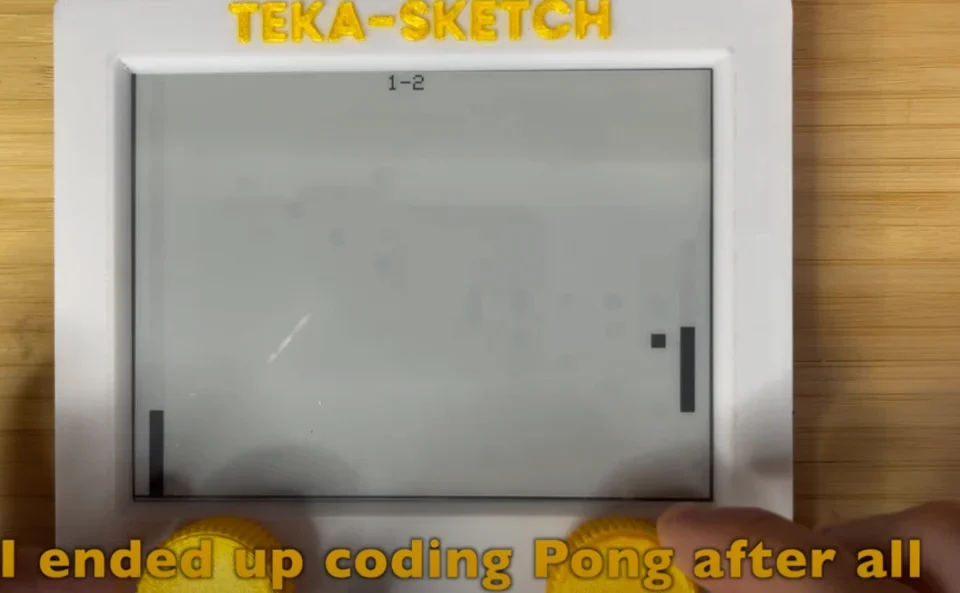
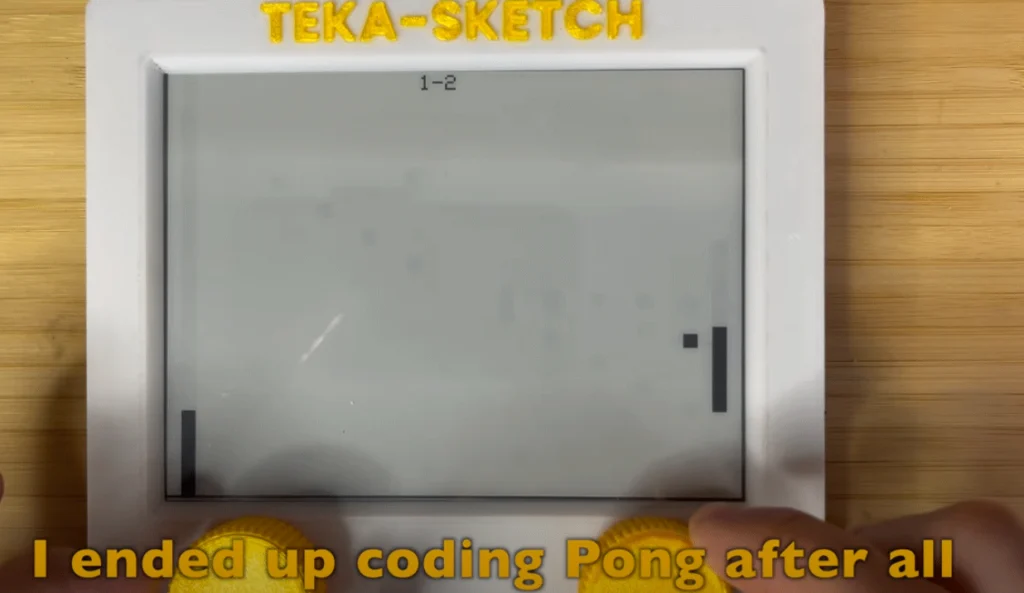
For over six decades, the Etch A Sketch has held a paradoxical position in the toy industry. It is universally recognized as a masterpiece of minimalist mechanical design—a screen of aluminum powder and a stylus manipulated by two tension-controlled knobs—yet it remains defined by its greatest frustration: the "all-or-nothing" nature of its canvas. A single misplaced line, a shaky hand, or a momentary lapse in concentration necessitated a vigorous, screen-clearing shake, erasing hours of painstaking work in an instant.
The TekkaSketch project has emerged as a definitive answer to this historical limitation. By wedding the tactile, analog soul of the original 1960s invention with the precision of modern microcontrollers and E-Ink technology, the project does more than just digitize a toy; it expands the definition of what a retro-inspired creative tool can achieve.
The Mechanics of Nostalgia: Understanding the Original
To appreciate the innovation behind TekkaSketch, one must first grasp the elegance of the original Etch A Sketch mechanism. Invented by André Cassagnes, the device relies on a surprisingly simple physical phenomenon. The internal glass screen is coated with a fine layer of aluminum powder. Two plastic styli, controlled by a complex internal pulley system connected to the external knobs, scrape the powder away from the glass.
The image created is not "drawn" in the traditional sense; rather, it is the negative space—the absence of powder—that forms the visible line. This reliance on friction and physical displacement meant that "undoing" an action was physically impossible without resetting the entire powder bed. For decades, designers and children alike accepted this as a fundamental constraint of the medium.
Chronology of Development: From Vacuum Dreams to E-Ink Realities
The journey to the TekkaSketch was not a straight line. The creator’s development process reads like a masterclass in iterative engineering, moving through several distinct phases of conceptualization.
The Experimental Phase
Initially, the primary design challenge was the implementation of an "undo" function. Early prototypes explored the possibility of a micro-vacuum system designed to selectively remove and reposition the aluminum powder. However, the mechanical complexity required to move a vacuum nozzle with the necessary precision proved to be a bottleneck. The weight, power consumption, and potential for mechanical failure made a vacuum-based solution impractical for a handheld device.
The Retro-Gaming Pivot
Stymied by the mechanical limitations of the powder system, the creator pivoted toward digital emulation, drawing inspiration from Nibbles.bas, the iconic 1990s Snake game for PC. This shift marked the birth of the TekkaSketch as a hybrid device. Early attempts to integrate this vision included:
- Augmented Reality (AR): Using smartphones to overlay digital lines onto the physical glass screen. While visually impressive, it failed to bridge the gap between physical knob movement and digital fluidity.
- Rotary Encoders: Replacing the original knobs with high-precision digital encoders to track physical movement.
- Transparencies: Attempting to layer physical fruit illustrations over the screen to gamify the drawing experience.
The Breakthrough
The final breakthrough came with the decision to abandon the aluminum powder screen entirely. By replacing the glass panel with a high-contrast E-Ink display and driving the system with an ESP32 microcontroller, the developer finally achieved the necessary responsiveness. The E-Ink screen provided the critical advantage of "bistability"—the image remains on the screen even when the device is completely powered off, perfectly mimicking the permanent nature of the original toy.
Supporting Data: Engineering the User Experience
The success of the TekkaSketch lies in the technical integration of hardware and software. To replicate the feel of the original, the software logic had to account for the physical variance in how users turn knobs.
The ESP32 Integration
The ESP32 acts as the "brain" of the device. It processes the inputs from two high-resolution rotary encoders, which replace the traditional mechanical knobs. One of the most significant challenges was the speed differential between the two encoders. Users often turn knobs at varying velocities, and the software had to compensate for these variances in real-time to ensure the digital cursor moved with the same fluid, linear motion as the original mechanical stylus.

Persistence and Refresh Rates
E-Ink technology is notorious for its slow refresh rates, which could have been fatal for a drawing application. However, by utilizing "partial refresh" techniques, the developer was able to update only the pixels changed by the movement of the stylus, rather than redrawing the entire screen. This results in a drawing experience that feels instantaneous to the human eye, maintaining the illusion of analog drawing.
The Snake Implementation
The integration of Snake demonstrates the device’s versatility. By using the rotary encoders as input controllers, the snake’s direction is determined by the rotation of the knobs. A unique feature of the TekkaSketch is the two-player mode, where each player controls an independent snake using their respective knob. This transforms a solo drawing tool into a competitive gaming console, showcasing the potential for future game development on the platform.
Official Perspectives and Creator Intent
In documentation provided by the development team, the philosophy behind TekkaSketch is described as "the preservation of tactile joy." The creator emphasizes that the project was never intended to replace the Etch A Sketch, but to honor it.
"We wanted to solve the ‘undo’ problem without losing the ‘knob’ experience," the project lead noted in a recent briefing. "The satisfaction of the physical knob is a tactile sensation that touchscreens simply cannot replicate. By keeping the mechanical interface but upgrading the digital backend, we’ve created a device that feels familiar in the hand but behaves with the modern functionality users expect."
Implications for the Maker Community
The TekkaSketch project serves as a compelling case study for the "Right to Repair" and "Maker" movements. By open-sourcing the design and utilizing widely available components like the ESP32, the project encourages enthusiasts to build their own versions.
Bridging the Generation Gap
The implications of this device extend beyond mere hobbyism. In an era where children are increasingly isolated behind glass-and-capacitive-touch screens, the TekkaSketch offers a bridge. It provides the tactile engagement of a physical toy while introducing users to the principles of programming and hardware integration. It is a tool that teaches as much as it entertains.
Future Potential
The scalability of the ESP32 platform means that the TekkaSketch is essentially a "blank slate." Future updates could include:
- Bluetooth Connectivity: Allowing users to save their drawings to a mobile app or share them on social media.
- Expandable Memory: Enabling the storage of multiple drawings.
- Customizable Brushes: Changing the digital "stroke" width or pattern, something that was physically impossible with the original powder-based system.
Conclusion: A New Chapter for a Classic
The TekkaSketch is more than a digital modification; it is an act of preservation through innovation. By identifying the specific mechanical limitations that have frustrated users for decades and applying modern, low-power technology to resolve them, the project has successfully extended the lifespan of a cultural icon.
It proves that nostalgia does not have to be stagnant. When we apply modern engineering to the artifacts of our past, we do not erase their history; we add a new layer to it. As the TekkaSketch continues to evolve, it stands as a testament to the idea that the best way to honor the past is to ensure it remains relevant for the future. Whether it is used as a sophisticated drawing tool or a nostalgic handheld gaming device, the TekkaSketch succeeds in making the classic "shake-to-erase" frustration a relic of the past, allowing creativity to flow without the constant fear of the accidental reset.